 USA
Oskar Zepeda
4 HYROX races over 2 seasons: 3 solo, 1 in a team with 1 partner.
One best per race type
Adaptive Men: finish time, race by race
Oldest to newest; a line going down means getting fasterThis line shows the finish time of Oskar Zepeda at each race, oldest on the left; lower is faster.The best was 1:26:16 at Houston (Mar 2026); Oskar Zepeda was 9:19 faster at the latest race than at the first.
See the numbers
| Race | Date | Division | Finish |
|---|---|---|---|
| Anaheim | Dec 2025 | Adaptive Men | 1:43:23 |
| Houston | Mar 2026 | Adaptive Men | 1:26:16 |
| Salt Lake City | Sep 2026 | Adaptive Men | 1:34:04 |
Each dot is one Adaptive Men race; click one for that race's report. Not enough complete, clean Adaptive Men races yet to measure the change.
4 results at 4 races

4th of 7 Adaptive Men.
| Part | Time | Typical here | vs 7 Adaptive Men here |
|---|---|---|---|
| Run 1: | 3:06 | ||
| SkiErg: | 4:42 | faster than 50% | |
| Run 2: | 5:47 | ||
| Sled push: | 3:21 | faster than 16% | |
| Run 3: | 6:11 | ||
| Sled pull: | 2:41 | fastest in the field | |
| Run 4: | 6:02 | ||
| Burpee broad jump: | 5:57 | faster than 80% | |
| Run 5: | 6:46 | ||
| Row: | — | ||
| Run 6: | 6:30 | ||
| Farmers carry: | 1:59 | faster than 66% | |
| Run 7: | 6:22 | ||
| Sandbag lunges: | 5:46 | faster than 50% | |
| Run 8: | 6:37 | ||
| Wall balls: | 8:21 | faster than 33% | |
| Roxzone: | 24:27 | faster than 0% | |
| Runs (8 km) | 47:17 | faster than 50% | |
| Stations (8) | — | ||
| Finish | 1:34:04 | 1:34:04 | 4th of 7 |


1,258th of 2,141 Doubles Mixed (faster than 41%). Against the 64 who finished around 1:31:14: most time gained on the roxzone (0:40), most lost on the eight runs (1:20). Runs 5 to 8 took 4:55 more than runs 1 to 4 (them: 3:23 more).
| Part | Time | Typical here | vs 2,141 Doubles Mixed here |
|---|---|---|---|
| Run 1: | 3:42 | 3:53 | faster than 60% |
| SkiErg: | 4:33 | 4:32 | faster than 49% |
| Run 2: | 6:16 | 5:55 | faster than 36% |
| Sled push: | 2:39 | 2:31 | faster than 41% |
| Run 3: | 6:42 | 6:18 | faster than 34% |
| Sled pull: | 4:10 | 4:06 | faster than 47% |
| Run 4: | 6:44 | 6:17 | faster than 34% |
| Burpee broad jump: | 3:47 | 3:27 | faster than 37% |
| Run 5: | 7:05 | 6:22 | faster than 30% |
| Row: | 4:51 | 4:55 | faster than 55% |
| Run 6: | 7:03 | 6:20 | faster than 28% |
| Farmers carry: | 1:52 | 1:48 | faster than 43% |
| Run 7: | 7:07 | 6:21 | faster than 28% |
| Sandbag lunges: | 4:57 | 4:00 | faster than 22% |
| Run 8: | 7:04 | 6:27 | faster than 34% |
| Wall balls: | 4:26 | 4:39 | faster than 59% |
| Roxzone: | 7:51 | 8:03 | faster than 54% |
| Runs (8 km) | 51:39 | 48:15 | faster than 35% |
| Stations (8) | 31:15 | ||
| Finish | 1:30:40 | 1:26:44 | 1258th of 2,141 · faster than 41% |

How to read
Place is the position among timed finishers in the same race, division and gender; a doubles place is the team's. Runs is the organiser's official run total (it can differ from the eight laps added up by a few seconds), stations the eight stations added up, and roxzone the time moving between them. A dash in runs, stations and roxzone on a result from the live results service means the splits are not in yet (finish time only). The age group is the one entered for that race; for a team it is the team’s age group. A dash means the organiser did not publish that number for the result.
1 team partner
- irene zepeda1 race
From the team results above. A name opens the search: a partner can have more than one page.
Salt Lake City 2026, against 7 Adaptive Men
Shape of the race
no splitCarryLungesWall ballsRoxzoneRuns
This chart shows where Oskar sat in the field on each part of the race: the edge is faster than everyone, the centre is the slowest.Strongest on Pull (faster than 99% of the field), weakest on Roxzone (faster than 0%).
See the numbers
| Part | Oskar: faster than |
|---|---|
| Ski | 50% |
| Push | 17% |
| Pull | 99% |
| BBJ | 80% |
| Row | no split |
| Carry | 67% |
| Lunges | 50% |
| Wall balls | 33% |
| Roxzone | 0% |
| Runs | 50% |
Further out means you beat more of the field on that part. A dent is a weak spot.
How you ranked on each station
How much of the field Oskar beat on each part of the race, at this race.Best: Sled pull (faster than 99%); weakest: Roxzone (faster than 0%).
Longer is better: the share of the field you beat.
Minutes against the typical finisher
This field was too small to work out typical splits; the place bars still compare against everyone in it.
The race as one bar: Oskar against the typical Adaptive Men finisher
This chart draws the race in order, left to right: each 1 km run (blue), each station (yellow) and the roxzone (grey), sized by its time.Oskar: 47:21 running, 32:47 at the stations and 24:27 in the roxzone; the longest station was the wall balls (8:21).
See the numbers
| Part | Oskar |
|---|---|
| Run 1 | 3:06 |
| SkiErg | 4:42 |
| Run 2 | 5:47 |
| Sled push | 3:21 |
| Run 3 | 6:11 |
| Sled pull | 2:41 |
| Run 4 | 6:02 |
| Burpee broad jump | 5:57 |
| Run 5 | 6:46 |
| Row | — |
| Run 6 | 6:30 |
| Farmers carry | 1:59 |
| Run 7 | 6:22 |
| Sandbag lunges | 5:46 |
| Run 8 | 6:37 |
| Wall balls | 8:21 |
| Roxzone | 24:27 |
| Finish | 1:34:04 |
The race in order, left to right. A wider block than the one below is slower than typical.
Training for the next one? Let's beat 1:26:16.
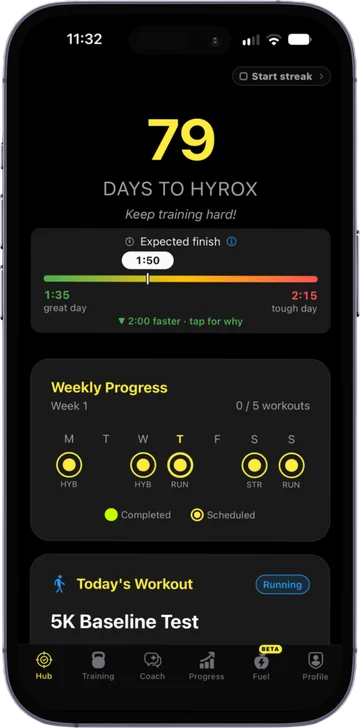
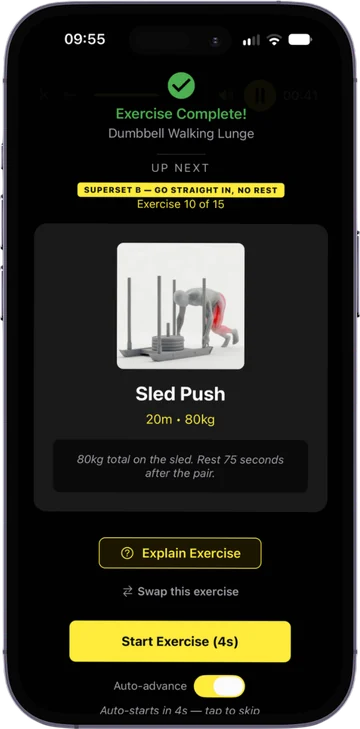
The RoxHype app is your training plan to race day: built from your splits, your kit and your race date, and adjusted every week.
- A week-by-week plan that counts down to your race
- Extra work on your slowest stations
- Adjusts every week to what you actually did
Free to download. Used by more than 40,000 HYROX athletes.