 USA
Alexandra Asacker
1 HYROX race over 1 season. Best Adaptive Women time: 1:32:40 at Boston 2026.
1 result at 1 race

4th of 10 Adaptive Women.
| Part | Time | Typical here | vs 10 Adaptive Women here |
|---|---|---|---|
| Run 1: | 4:11 | ||
| SkiErg: | 3:34 ‡ | ||
| Run 2: | 5:58 | ||
| Sled push: | 1:53 | faster than 75% | |
| Run 3: | 6:09 | ||
| Sled pull: | 2:48 | fastest in the field | |
| Run 4: | 6:11 | ||
| Burpee broad jump: | — | ||
| Run 5: | 6:08 | ||
| Row: | 3:21 ‡ | ||
| Run 6: | 6:13 | ||
| Farmers carry: | 1:48 | faster than 88% | |
| Run 7: | 6:20 | ||
| Sandbag lunges: | — | ||
| Run 8: | 7:43 | ||
| Wall balls: | 7:35 | faster than 37% | |
| Roxzone: | — | ||
| Runs (8 km) | 48:50 | faster than 57% | |
| Stations (8) | — | ||
| Finish | 1:32:40 | 1:43:59 | 4th of 10 |
How to read
Place is the position among timed finishers in the same race, division and gender; a doubles place is the team's. Runs is the organiser's official run total (it can differ from the eight laps added up by a few seconds), stations the eight stations added up, and roxzone the time moving between them. The age group is the one entered for that race. A dash means the organiser did not publish that number for the result.
Boston 2026, against 10 Adaptive Women
Shape of the race
no splitPushPullBBJ
no splitRow
no splitCarryLunges
no splitWall ballsRoxzone
no splitRuns
This chart shows where Alexandra sat in the field on each part of the race: the edge is faster than everyone, the centre is the slowest.Strongest on Pull (faster than 99% of the field), weakest on Wall balls (faster than 38%).
See the numbers
| Part | Alexandra: faster than |
|---|---|
| Ski | no split |
| Push | 75% |
| Pull | 99% |
| BBJ | no split |
| Row | no split |
| Carry | 89% |
| Lunges | no split |
| Wall balls | 38% |
| Roxzone | no split |
| Runs | 57% |
Further out means you beat more of the field on that part. A dent is a weak spot.
How you ranked on each station
How much of the field Alexandra beat on each part of the race, at this race.Best: Sled pull (faster than 99%); weakest: Wall balls (faster than 38%).
Longer is better: the share of the field you beat.
Minutes against the typical finisher
This field was too small to work out typical splits; the place bars still compare against everyone in it.
The race as one bar: Alexandra against the typical Adaptive Women finisher
This chart draws the race in order, left to right: each 1 km run (blue), each station (yellow) and the roxzone (grey), sized by its time.Alexandra: 48:53 running and 14:04 at the stations; the longest station was the wall balls (7:35).
See the numbers
| Part | Alexandra |
|---|---|
| Run 1 | 4:11 |
| SkiErg | — |
| Run 2 | 5:58 |
| Sled push | 1:53 |
| Run 3 | 6:09 |
| Sled pull | 2:48 |
| Run 4 | 6:11 |
| Burpee broad jump | — |
| Run 5 | 6:08 |
| Row | — |
| Run 6 | 6:13 |
| Farmers carry | 1:48 |
| Run 7 | 6:20 |
| Sandbag lunges | — |
| Run 8 | 7:43 |
| Wall balls | 7:35 |
| Roxzone | — |
| Finish | 1:32:40 |
The race in order, left to right. A wider block than the one below is slower than typical.
Training for the next one? Let's beat 1:32:40.
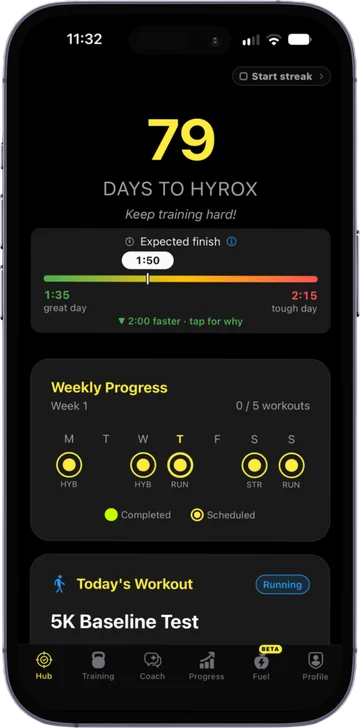
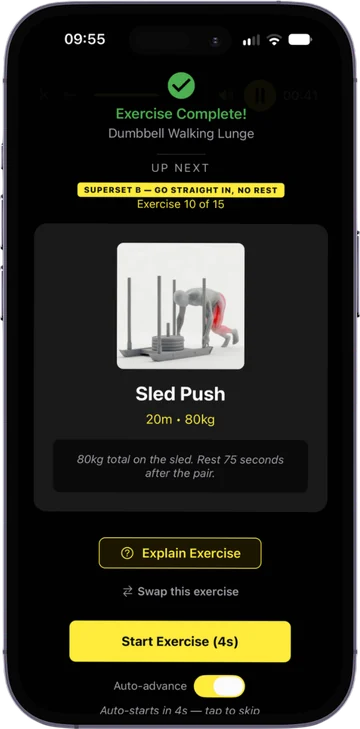
The RoxHype app is your training plan to race day: built from your splits, your kit and your race date, and adjusted every week.
- A week-by-week plan that counts down to your race
- Extra work on your slowest stations
- Adjusts every week to what you actually did
Free to download. Used by more than 40,000 HYROX athletes.